
Stationary Thermoforming Molds
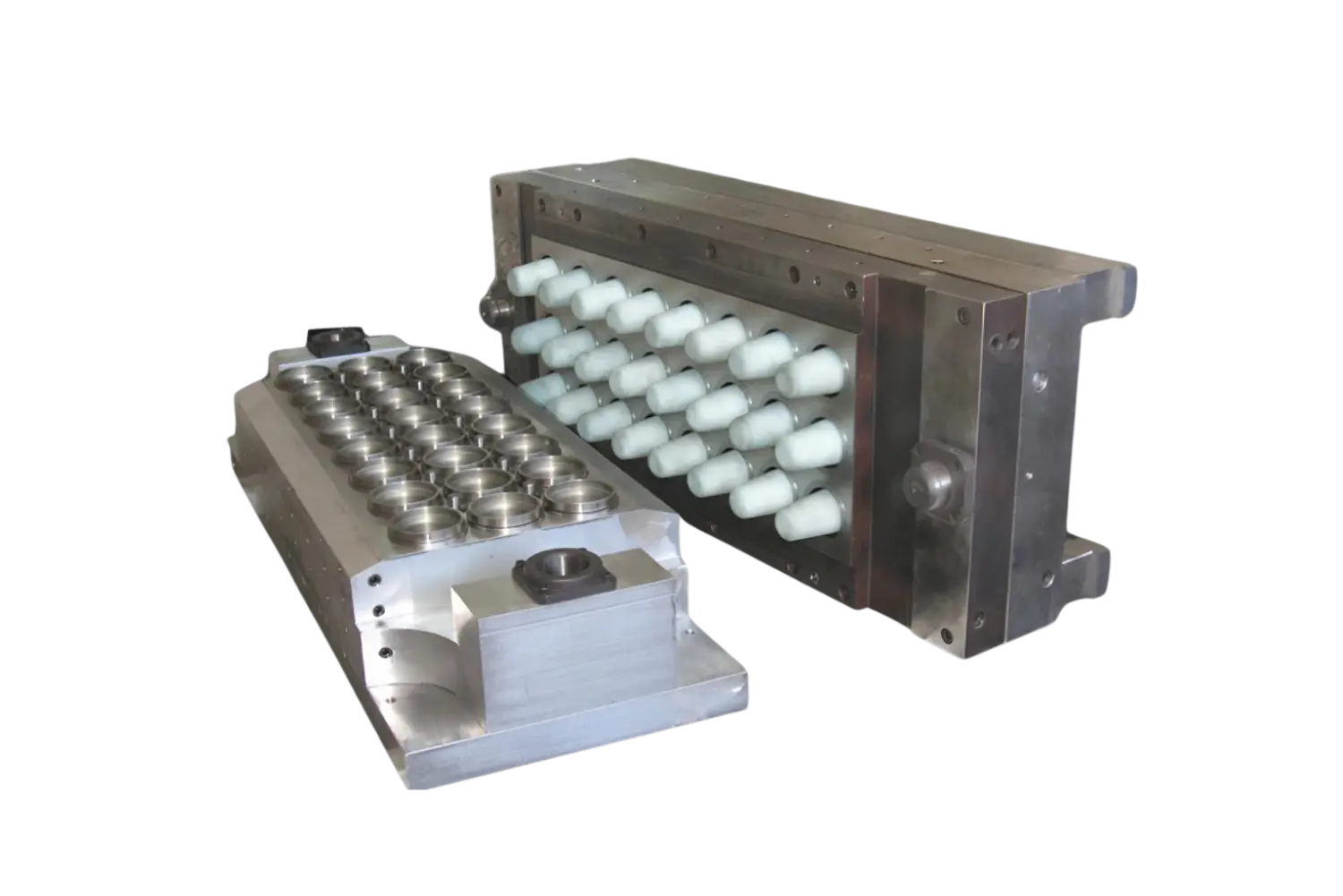
Quick Summary: Stationary thermoforming molds are advanced mold solutions that manage forming and cutting steps in separate stations, offering higher precision, more controlled cutting quality, and flexible production planning for multi-compartment packaging.
Stationary Thermoforming Molds: Precise and Versatile Production Solutions
Efficiency in the production of plastic packaging and industrial plastic products depends not only on machine speed but also on how accurately the mold accompanies the process. Stationary thermoforming molds developed by Cag Machine offer a strong production infrastructure for businesses seeking high precision, controlled cutting, and flow management suitable for product geometry. Especially in multi-compartment containers, fruit-vegetable packaging, egg trays, and detailed formed products, this mold approach aims to maintain quality standards, keep waste at a more manageable level, and strengthen production repeatability.
This category is an important sub-solution of the Thermoforming Molds group. If your business wants not just to give form to a product family but also to make post-forming cutting discipline more controlled, a stationary structure becomes a more strategic choice in most scenarios.
What is a Thermoforming Mold?
A thermoforming mold is the tooling system that provides a specific form to a heated plastic sheet and creates the final geometry of the product. It directly affects not just the shape of the product, but also its edge order, surface quality, dimensional repetition, cooling behavior, and cycle stability on the production line. Therefore, selecting a thermoforming mold is not just a tool preference, but a critical decision in terms of production quality and total operating cost.
- Giving the target product geometry to the plastic sheet
- Managing vacuum, pressure, and cooling flow according to the product structure
- Maintaining dimensional repetition and product standards
- Ensuring cycle stability by supporting mold-to-machine compatibility
- More consistent form and cutting quality
- More controlled waste rate
- Faster product changeover and recipe transitions
- Longer mold life and more planned maintenance processes
What is a Stationary Thermoforming Mold?
A stationary thermoforming mold is a mold structure developed for systems where fundamental steps such as forming and cutting are managed in different stations on the production line. This distinction provides a great advantage especially for multi-compartment, detailed, or products requiring precision cutting. Because forming and final cutting do not happen simultaneously, but progress within a controlled process flow. This strengthens product centering discipline, cutting accuracy, and visual standards.
- Controlled heating of the plastic sheet
- Forming of the product in the forming station
- More precise final separation in the cutting station
- Product discharge and stacking conducted according to process order
- High cutting precision
- Stronger performance in multi-cavity and detailed packaging
- Flexible production setup suitable for product diversity
- More balanced mold life with optimized cooling
Cag Machine Stationary Mold Technology and Production Process
| Production Stage | Applied Technology | Benefit Provided |
|---|---|---|
| Design and Modeling | Engineering analysis, product-oriented 3D modeling, and line compatibility assessment | Helps the mold adapt more accurately to the target product, machine, and process flow. |
| Precision Machining | CNC precision machining technology and tolerance-controlled tool production | Provides smooth edge structure, millimetric dimensional repetition, and more consistent form quality. |
| Thermal Management | Aluminum alloy body, optimized cooling channels, and balanced heat distribution planning | Contributes to more stable cycle times and protects the life of the mold. |
| Vacuum and Air Flow | Vacuum and air channel design suitable for product geometry | Helps achieve clearer form on detailed surfaces and multi-compartment products. |
| Quality Assurance | Dimensional control, process testing, and verification according to high-speed line scenarios | Offers more reliable and repeatable performance on high-capacity production lines. |
Difference Between Stationary and Tilt Mold Thermoforming Molds
The correct choice of mold and system depends on the depth, geometry, cycle expectations, and discharge logic of the product to be produced. Stationary thermoforming molds stand out with a more controlled process logic where forming and cutting steps are separated; while tilt mold thermoforming molds manage product discharge and cycle tempo with a different approach, especially in cup and deep container production.
Stationary Thermoforming Molds
Offers a powerful solution in terms of cutting quality, dimensional repetition, and production control for multi-cavity packaging, trays, and detailed geometries.
Cutting Precision Detailed ProductsTilt Mold Thermoforming Molds
Creates a strong alternative for businesses wanting to manage discharge logic and cycle rhythm differently in deep container and cup production.
Deep Containers Cup ProductionWhy is Mold Compatibility with Thermoforming Machines So Important?
Mold performance remains incomplete when evaluated on its own. Real efficiency emerges from the synergy the mold establishes with the Thermoforming Machines it operates on. Heating balance, station transitions, vacuum behavior, and product discharge become more controlled thanks to the technical integrity between the mold and the machine.
While evaluating stationary mold solutions, you can review the top category Thermoforming Molds page and consider our Thermoforming Machine solutions together to assess mold-machine compatibility more accurately.
Frequently Asked Questions
What Does a Stationary Thermoforming Mold Do? +
In Which Products are Stationary Molds Most Preferred? +
What is the Fundamental Difference from Tilt Mold Thermoforming Molds? +
Why is Mold-to-Machine Compatibility So Important? +
Blog
For Technical Support and Inquiries
For technical information requests, you can contact us through our communication channels.
- +90 533 1345807
- info@cagmakina.com
- Zafer Mahallesi 146. Sokak Oz Sefa Is Merkezi No:21/6 Esenyurt Istanbul, TURKEY